0 items

Natural cannabinoids: list, effects and differences (CBD, CBG, CBC, CBN…)
Reading time
⌛
9 min
Summary :
- Summary table of natural cannabinoids
- What is a natural cannabinoid?
- Major and minor cannabinoids: what's the difference?
- How are cannabinoids created?
- The best-known minor and major natural cannabinoids
- Delta-9 THC: Tetrahydrocannabinol
- CBD: Cannabidiol
- CBG: Cannabigerol
- CBN: Cannabinol
- CBC: cannabichromene
- THCV, CBDV, CBCV, CBGV: cannabinoids in the "varine" form
- THCP, CBDP, CBCP, CBGP: cannabinoids in the form of “phorol” or “biphorol”
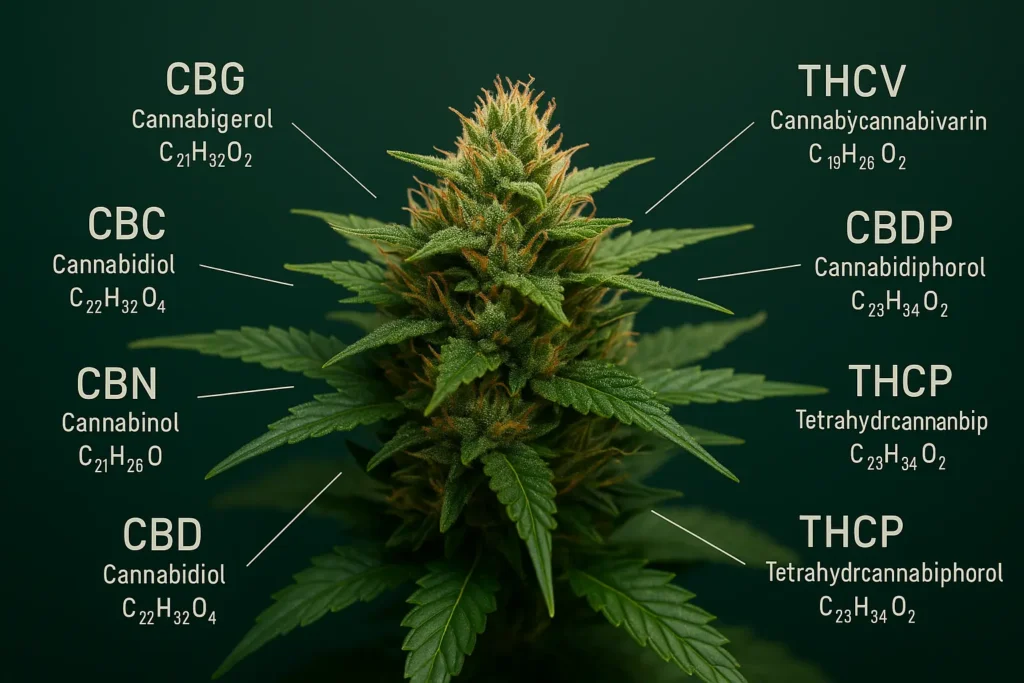
CBD, CBG, CBC, CBN… Are you having trouble finding your way among all these acronyms? That's perfectly normal, there are more than 100 natural cannabinoids synthesized by cannabis.
But it's not inevitable either: to help you find your way around, we've prepared a list of the best-known natural cannabinoids, with their full name, acronym, effects and some additional information to impress your friends!
Summary table of natural cannabinoids
| Cannabinoid | Concentration | Main effects | Legal status in France |
|---|---|---|---|
| CBD Cannabidiol |
15-30 % | Relaxation, mild anxiolytic | Legal |
| THC Tetrahydrocannabinol |
5-30% (cannabis) | Psychoactive, euphoric | Amazing |
| CBG Cannabigerol |
< 1 % | Modulator, mildly stimulating | Legal |
| CBN Cannabinol |
Traces | Sedative | Legal |
| CBC Cannabichromene |
< 1 % | Entourage effect | Legal |
| THCV Tetrahydrocannabivarin |
Traces | Appetite suppressant, energizer | Legal < 0.3% (natural form) |
| CBDV Cannabidivarine |
Traces | Similar to CBD, but more intense | Legal |
| CBGV Cannabigerovarine |
Traces | Related to CBG | Legal |
| CBCV Cannabichromevarine |
Traces | Related to CBC | Legal |
| THCP Tetrahydrocannabiphorol |
~0,01 % | High endocannabinoid affinity | Amazing |
| CBDP Cannabidiol |
~0,01 % | Elongated form of CBD | Legal |
| CBGA Cannabigerolic Acid |
Present in fresh flowers | Acid precursor, unique properties | Legal |
| THCA Tetrahydrocannabinolic Acid |
Present in fresh flowers | Acid precursor to THC, non-psychoactive | Grey zone (close to THC) |
| CBDA Cannabidiolic Acid |
Present in fresh flowers | Acid precursor of CBD | Legal |
What is a natural cannabinoid?
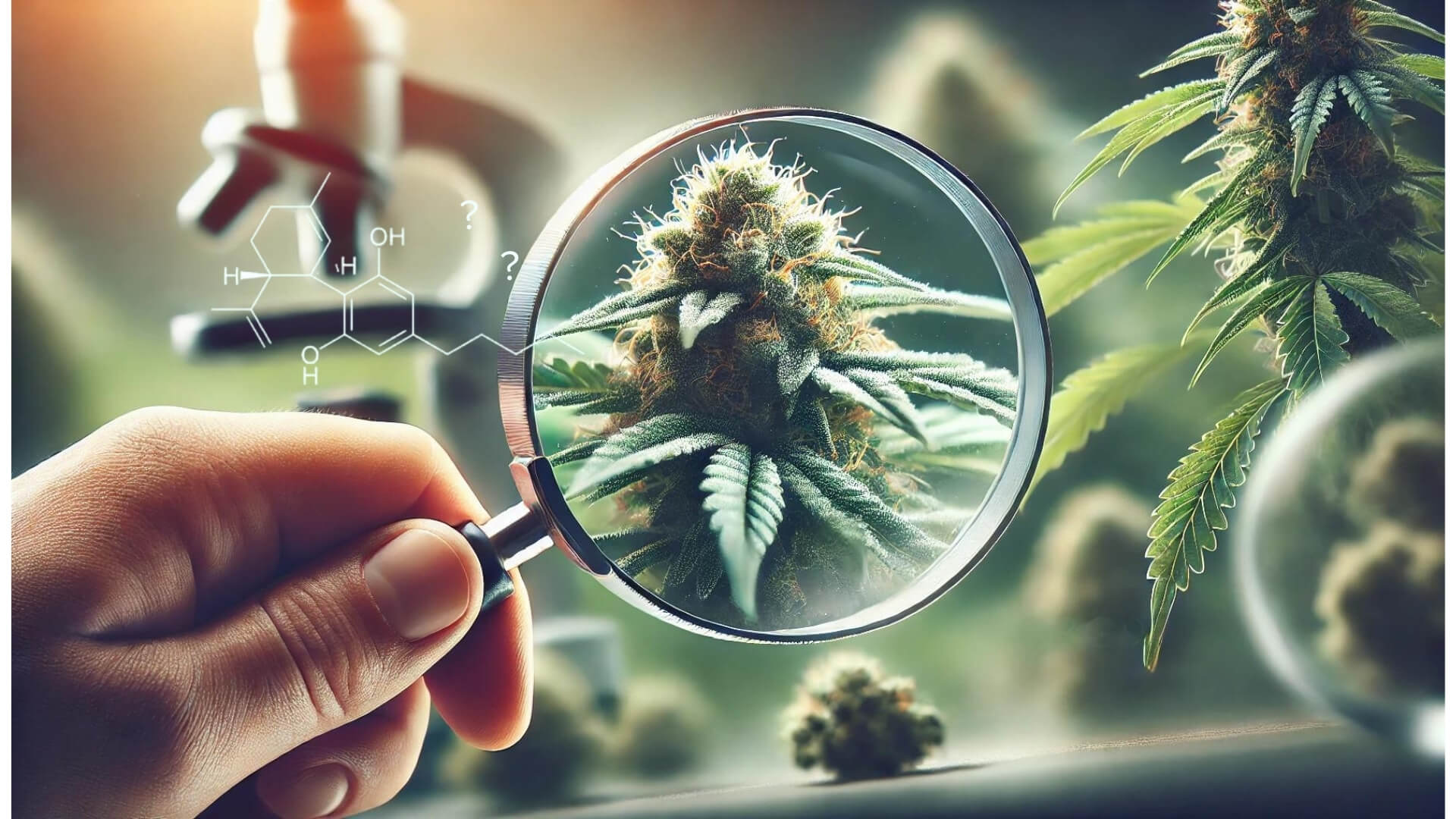
Natural cannabinoids, also called phytocannabinoids, are molecules produced by plants of the genus Cannabis. This genus includes sativa, indica, and ruderalis varieties, all of which belong to the Cannabaceae botanical family.
Cannabinoids are considered "natural" when they are produced directly by the plant through its biological processes, without human intervention. These are the well-known substances found in the flowers and resins of cannabis and hemp: CBD, THC, CBG, CBC, etc.
Major and minor cannabinoids: what's the difference?
The terms major cannabinoids and minor cannabinoids form entirely artificial groups, created by the scientific literature for classification purposes.
The most abundant cannabinoids, the first discovered and the most studied, are distinguished as major cannabinoids. These are cannabidiol (CBD), tetrahydrocannabinol (THC), cannabigerol (CBG) and cannabinol (CBN).
By exclusion, all other cannabinoids are said to be "minor" or "secondary".
Each cannabinoid has its own particularities, but many share a similar chemical structure: they all belong to the large family of phytocannabinoids, which come from the same biosynthetic pathway.
How are cannabinoids created?
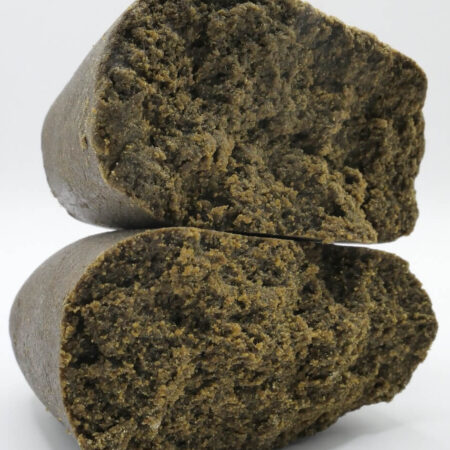
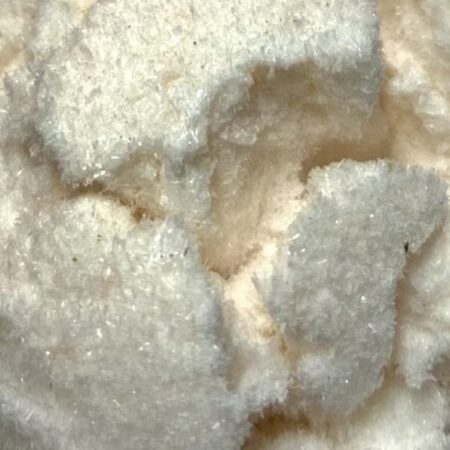
Most phytocannabinoids are synthesized during the growth and drying of cannabis flowers.
This is a complex biological process. Simply put, the plant first produces a key molecule: CBGA (cannabigerolic acid), often called the "mother molecule."
Depending on the plant's genetics, varying amounts of CBGA are converted into other cannabinoid acids by specific enzymes.
This results in different levels of THCA, CBDA, CBCA, etc.
It is during the drying of the flower that these acidic forms are transformed into “classic” cannabinoids, such as THC, CBD, CBG, etc.
The best-known minor and major natural cannabinoids
Now that we have seen what a cannabinoid is and how it is created, we will examine each cannabinoid in detail.
Delta-9 THC: Tetrahydrocannabinol
We begin with the most well-known cannabinoid: THC. Scientifically, it is called Delta-9 THC, in checkout to distinguish it from other forms of THC present but much less concentrated such as Delta-8 THC and Delta-10 THC.
THC is known for its action on the endocannabinoid system, particularly on CB1, which gives it the well-known psychoactive effects:
- Alteration of perception (time, space, sounds)
- Euphoria, high feeling
- Impaired attention and cognitive slowing
- Increased appetite
- Sensation of muscle relaxation
- Dry mouth
- Red eyes
But THC is also known for its addictive effects, as well as its undesirable effects (anxiety, paranoia…) which justify its classification, almost worldwide, as a narcotic.
CBD: Cannabidiol
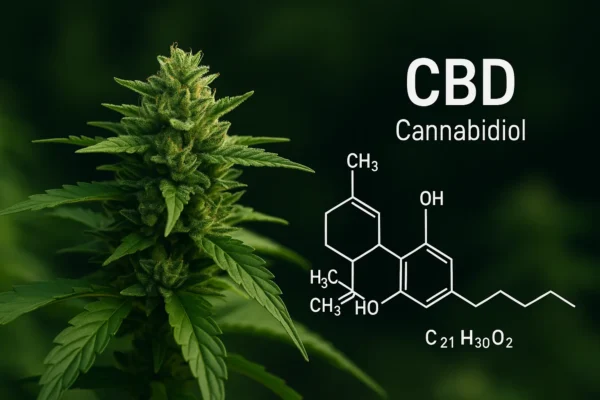
The second on our list is of course CBD. This cannabinoid is the second most concentrated in cannabis, particularly in indica.
Unlike THC, it does not interact directly with the endocannabinoid system, which partly explains the difference in its effects. Indeed, cannabidiol does not produce a " high," but it can produce a wide range of effects. Among them, the most frequently cited are:
- Physical and mental relaxation
- A mild calming and anxiolytic effect
- A feeling of muscle relaxation
Cannabidiol has a modulating effect that promotes biological balance ; as such, it is recognized by most European states as a safe and harmless cannabinoid.
CBG: Cannabigerol
Although it was the first cannabinoid created in acidic form, CBG is actually present in relatively small amounts in CBD flowers. Most of the time, its concentration is less than 1% of the total cannabinoids present.
Like CBD, CBG has only a weak effect on the endocannabinoid system, giving it modulatory effects. Cannabigerol is generally described as more stimulating than CBD, and reviews confirm this.
- A slight improvement in concentration
- From a reduction in appetite
- Relaxing effects
It could also help promote well-being and emotional balance.
Discover all our CBD flowers
CBN: Cannabinol
CBN is a particularly interesting cannabinoid , since it is not produced directly by the plant. It appears naturally through the degradation of THC, when the latter ages or oxidizes under the influence of heat, light, or oxygen.
In simplified terms, tetrahydrocannabinol (THC) and cannabinol (CBN) share a very similar structure: CBN can be seen as a more oxidized and "older" form of THC. Over time, THC loses some hydrogen atoms and its ring becomes rigid, leading to the natural formation of CBN.
It is this oxidation process that explains why more CBN is found in flowers or resins that have been stored for a long time or exposed to heat.
Although derived from THC, cannabinol are completely different. With a very mild high, it doesn't produce euphoria. It 's known for its sedative effects, making it a good candidate for helping with sleep.
CBC: cannabichromene
CBC is arguably one of the cannabinoids that attracts the least attention, for a fairly simple reason: it produces few perceptible effects on its own . Since it barely binds to the CB1 receptors of the endocannabinoid system, CBC is often described as providing a very subtle feeling of calm , even more discreet than that of CBD.
In reality, some studies mainly suggest that CBC could play a role in the entourage effect : its presence would modify the way other cannabinoids are felt, in particular by softening or balancing some of the effects of THC.
It is a “background” cannabinoid, not very spectacular on its own, but which would contribute to the overall effect of a flower or resin.
CBDA, THCA, CBGA: cannabinoids in acidic form
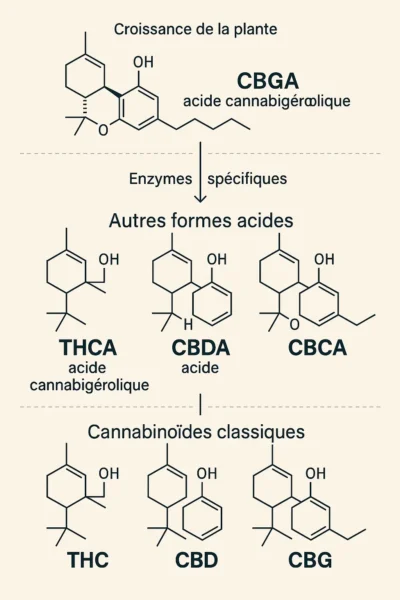
As we saw in the section on the formation of natural cannabinoids, before becoming the molecules we know, cannabinoids first exist in an acidic form : CBGA, THCA, CBDA, CBCA, among others.
Primarily found in fresh flowers, these acidic forms have long been considered “inactive” because they produce little or no noticeable effects.
However, recent research has shown that these acidic molecules possess their own biological effects , sometimes even more targeted than theirboxproperties versions. Some exhibit marked anti-inflammatory, antioxidant, or anti-nausea , without psychoactive effects or alterations in perception .
They therefore represent a very interesting avenue for medical research. However, much more research is needed to fully understand their potential and the mechanisms that govern them.
THCV, CBDV, CBCV, CBGV: cannabinoids in the "varine" form
Yes, indeed! Although this group of cannabinoids became best known thanks to THCV , which gained popularity before its 2023 ban, cannabinoids in the varine occur naturally. This is why natural THCV has been reclassified and remains legal at concentrations below 0.3%.
Cannabinoids whose names end in -varine (such as THCV, CBDV, CBCV, and CBGV, to name just the most well-known) are quite similar to their "classic" counterparts.
Most differ molecularly only by a shorter side chain : a simple structural change, but one that influences their biological behavior, as well as their potential and perceived effects.
They are generally considered to have a more vivid and less lasting effect than their classic counterparts.
THCP, CBDP, CBCP, CBGP: cannabinoids in the form of “phorol” or “biphorol”
Discovered recently, in 2019, the so-called phorol or biphorol forms represent another rare family of natural cannabinoids. They can be seen as the “inverse twins” of the -varine forms.
Whereas α-varines have a shorter side chain (C3), biphorols, on the contrary, have a longer chain (C7). This simple elongation modifies their biological behavior: it strengthens the binding with endocannabinoid receptors, which can influence the nature and intensity of their effects.
These molecules do exist naturally in certain hemp varieties, but in minute quantities, often on the checkout of 0.01% or less. Their recent discovery has primarily allowed for a better understanding of the fundamental role of side chain length in cannabinoid activity.
FAQ
What are the natural cannabinoids?
The list is long: there are over 100 different natural cannabinoids. Among them, the most frequently cited are: • THC • CBD • CBG • CBN • CBC
What is a cannabinoid?
Cannabinoids are substances naturally synthesized by cannabis or hemp plants. Along with terpenes and flavonoids, cannabinoids are among the many active compounds secreted by these plants.
What is the most potent natural cannabinoid?
The most potent natural cannabinoid is believed to be THCP. According to preliminary studies conducted at the time of its discovery, THCP influences the endocannabinoid system more than 30 times more than THC. However, like THC, it is currently illegal in France and most European countries.
How to activate natural cannabinoids?
To activate cannabinoids,boxis necessary. The simplest way is to place your flowers or resins in the oven at 110°C for approximately 30 minutes.
What is the difference between CBD and CBN?
CBD is one of the major cannabinoids in cannabis and hemp: it is the most naturally concentrated cannabinoid after THC. CBN, on the other hand, is a secondary cannabinoid, produced by the breakdown of THC.
Are cannabinoids only produced by hemp?
It was long thought that phytocannabinoids were produced exclusively by cannabis, but today we know that some can be found in other plant species, such as rhododendron, certain legumes and some fungi.
What is the difference between a natural cannabinoid and a synthetic cannabinoid?
Natural cannabinoids are produced biologically by the hemp plant. Synthetic cannabinoids, on the other hand, are manufactured in laboratories, often from transformed molecules such as terpenes. Some, like THCP, do occur naturally but in quantities too small to be extracted like CBD: created in a laboratory, they are sometimes called semi-synthetic. Others, like H4CBD or H3CBN, are entirely artificial molecules: they do not exist in nature and are therefore synthetic cannabinoids.
Are all natural cannabinoids legal in France?
No. In France, CBD, CBN, CBG, and their derivatives in the form of varine or phorol are legal. THC and its derivatives (THCV, THCP, etc.) are illegal. However, current legislation evolves over time; we encourage you to stay regularly informed of these changes.
Do all cannabinoids act in the same way?
No. Each cannabinoid, terpene, and flavonoid interacts differently with the endocannabinoid system. Some, like THC, bind directly and strongly to CB1 and CB2 receptors, which explains their psychoactive effects. Others, like CBD, do not act directly on these receptors: they influence other systems, notably the TRPV1 and TRPV2 receptors, which interact indirectly with the endocannabinoid system. This diversity of interactions explains the differences in effects between each cannabinoid, as well as the phenomenon known as the entourage effect.
What is the entourage effect?
The entourage effect refers to the natural synergy between the cannabinoids, terpenes, and flavonoids present in hemp. Together, these compounds complement each other and modulate their respective effects, thus altering how each cannabinoid acts when consumed with others. It is this interaction that often makes full-spectrum products more balanced, or even more potent, than isolated CBD. Conversely, some compounds can soften or balance the effects of other cannabinoids. For example, THCV tends to mitigate some of the effects of THC.